
AWF: Auditioning While Female
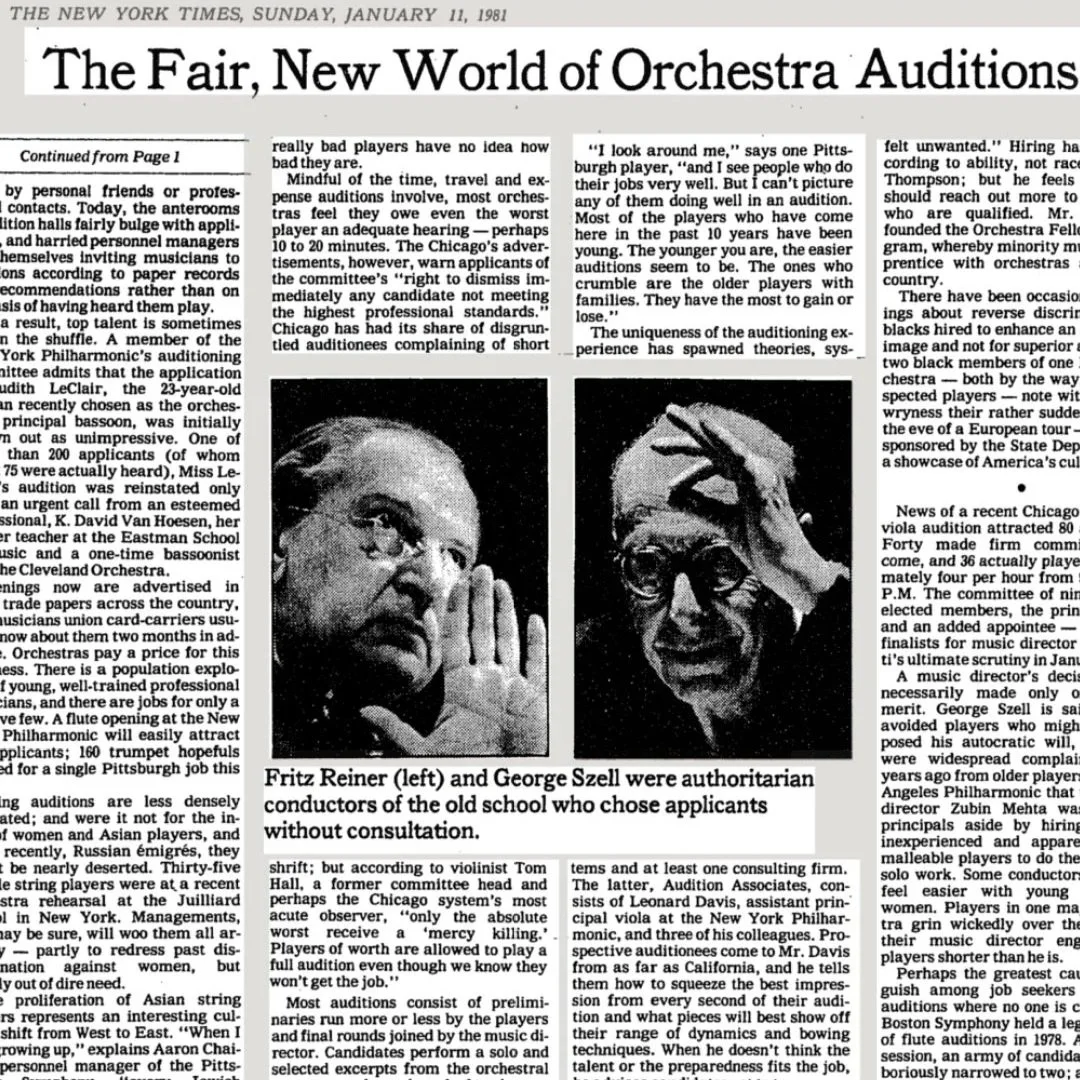
From The New York Times: January 11, 1981: “The Fair, New World of Orchestra Auditions”
Pas de Deux begins with an audition.
My very first orchestra audition - my first real one - was for the Philadelphia Orchestra.
That was a mistake. I knew even walking into the warm-up room that I was way out of my league, but I can't blame my lack of advancing past the prelim on anyone other than myself. I wasn't ready.
I'd be hard-pressed to feel "ready" to audition for Philly now, 19 years later, if that tells you anything.
And to be completely honest, that's what I remember from the audition: it went fine. I do remember my left-hand flying off the fingerboard for seemingly no reason at all, floating through the universe until I slapped it back on in the middle of a scale in Beethoven Seven. Long story short, my not advancing was not a surprise.
Most of my auditions fall into that category: I remember only the vaguest of details, because there were very few disasters.
There was a wonderful (awful) surprise in Minnesota, where I thought I'd be behind a screen and dressed for the weather (hint: polar vortex in Minneapolis). Think thickest jeans possible, a sweater that was peak fuzzy and warm, and a t-shirt layered underneath with a cartoon cat masquerading as a hot-dog.
There was no screen.
Every other candidate was dressed to the nines: concert blacks, shiny shoes, hair done.
I'd come in with a hat and gloves on. My hair was… well, imagine accordingly.
Anyway, I had to keep the sweater on to prevent them from seeing the hot-dog cat, so I played my round running about a thousand degrees, red-faced with heat and my own embarrassment, and it still went… fine.
Even without the anonymity granted by screen, I felt respected. I was given more than enough time to play and prove what I could (and couldn't) do. Across my audition run, I have enjoyed the benefit of carpeted runs on stage to prevent the committee from distinguishing heels versus flats, and screens to keep them from knowing my race, gender, or general appearance. Proctors have spoken for me. Lists have been curated to either be exactly the same from start to finish (assigned Bach?! The horror!). Some orchestras reveal their excerpts one at a time on stage.
Across my time serving on committees, I’ve seen equal time rules: each candidate is able to play for at least five minutes. It seems incredibly short out of context, but what a gift when you've been cut after an agonizing three months of preparation and thirty seconds on stage. We've taken away committee discussions of candidates until after the voting each round, and only allow it if a candidate is within a vote or two of advancing. We keep the screen up through the entire process, including finals and super finals.
In the year of whatever Sweet Baby Deity you believe in 2026, duh.
Pas de Deux, on the other hand, takes place eighty years ago, and the audition it opens with is a horror story I've heard time and time again across the generations of musicians I've worked with. This article from the New York Times in 1981 does a fairly good job at summing up where things were before this herculean attempt at fairness by our Nation's Top Men™: "The Fair, New World of Orchestra Auditions"
You’ll notice that there’s an overall theme to the article, though: what happens if the best talent gets drowned when we open the floodgates to everyone? In 2026, a different question seems more appropriate: what if the best talent can’t get to the audition? What if they can’t afford the gas or the plane ticket to make the trip? What if they can’t take off work long enough to leave town or even get their practicing in?
What if a committee is determined to hire the person they want, and not necessarily the best person at the audition?
"Gone as well is overt sexual and racial discrimination[...]." It’s a nice thought for 1981. Forty-five years later, people are still going to people. When orchestra commit to making auditions as equitable as possible, they chip away at the discrimination that starts well before a candidate even gets close to the door of the concert hall… but it’s a process, not a check-mark on a list.
In Pas de Deux, our fictional heroine, Charlotte "Charlie" Miller, begins the book by walking on stage as herself. It’s July 1946. There is no carpet. There is no screen. There is a committee, run by a tyrant (not even the Music Director!), who is already bored and irritated by the women he has to hear "in fairness" throughout the day. Charlie's preparation has consumed her life, her dream more important than anything else she can conceive of… and she's cut off at the knees before she can even get going. In more ways than one. Is it any wonder she's driven to do something drastic?
From 2009 - 2018, I took… a lot of auditions, and some of them worked out. Not once did I feel cut off at the knees, no matter how the course of the day went. And I still battled the insecurity, depression, and rebuilding that bloomed after each one, like a dark little rose bush. You build a lot of character going through this process, even when it’s fair to you.
The joy of Pas de Deux is that the story only begins with that horrible audition. We get to see Charlie's work toward triumph over the course of the book (spoiler). But… writing that opening scene, I could feel her indignation. I understood her anguish.
And I know, that if I existed in her generation, or the generation of that 1981 article, indignation would be a conflagration. We have come so far, my friends, and we still have such a ways to go.