
Pas de Deux (A teaser)
July, 1946
Chapter 1: Charlotte
Charlotte Miller let the low “C” linger, its resonance warm and blooming before she launched further into Bach’s Third Suite Prelude.
It sounded absolutely gorgeous in Symphony Hall.
She knew it would. She knew this stage. She'd spent thousands of hours here, first as a substitute for the Pittsburgh Orchestra and then in solo practice sessions, preparing for this exact moment: to make this permanent. To earn the seat she'd warmed during the war.
Her viola sang to the rafters, each note burnished and shining. The war was over. Charlie couldn't think too hard about the aftermath; the joy of things returning to normal - as normal as they could be - juxtaposed against the vacant seats left in its wake. Good men and women who'd laid their instruments aside in favor of a uniform, not knowing it would be for good.
The empty chairs that Charlie was able to fight for, now.
The tiniest shudder worked down her neck and through her shoulders; Charlie breathed through it. Her hand didn't falter; her bow didn't shake. Theo had returned, safe and physically whole; his own audition was in a few hours. They were going to join this section together: the Miller twins, reunited on stage as tenured, permanent members of their hometown orchestra.
They way things were meant to be.
And the only thing that stood in their way was this audition. Bach's series of exquisitely crafted scales flew under her fingers; Charlie had tried once to track the hours she'd spent on it. Too many. Not enough - never enough, for Bach - but for this committee… she launched into the arpeggiation, pulling her bow across three strings as the chord progression spiraled out. This Prelude was her calling card, but more than that, it was proof that she deserved a place here. Shifting harmonies waxed and waned, floating out toward the committee. Charlie risked a look up to see how they were received -
That was a mistake.
She almost wobbled. Her hands carried on even as her eyes widened. While some members leaned forward, paying rapt attention, the committee chair… heat rushed up through her neck, pulsing in her ears. Principal Violist Boris Lednov was twisted around, whispering into the ear of Principal Cellist Owen McIntosh. Based on the completely neglected notepad in front of him, he wasn't bothering to receive anything.
She pulled furiously into the explosive chord changes, hitting the open G string just a touch harder than originally intended. The irritation added a nice boost of intensity but she worked to rein her anger in. Lednov's opinion was important, but he wasn't the entire committee. He was just chairing it, and the rest knew she could play. She'd been an asset. She was an asset, she brought something great to this section -
Clear across the plush, burgundy velvet seats, Lednov rolled his eyes in absurdly exaggerated exasperation. “Thank you,” he called out, sighing audibly as Charlie ground to a stunned halt at the height of Bach’s masterpiece.
A flurry of motion burst through the committee; hands unsteepled, legs lowered to the ground. McIntosh narrowed his eyes and leaned forward -
But not a word was spoken, and Lednov waved casually toward stage. "“Beethoven’s Fifth, second movement. The usual spots, please.”
Charlie swallowed a surge of indignation. Lednov sounded bored. One of the open vacancies was his Associate Principal; he couldn't possibly be so checked out of his own standpartner's audition.
Or, at least, he couldn't check out if she made her first excerpt spectacular. She inhaled sharply through her nose and set bow to string -
“You know the usual spots, I presume?”
Everyone knows the usual spots, Lednov. Charlie’s right eye spasmed, but she nodded and kept her mouth shut. Broadcasting her displeasure would be a mistake, no matter how determined Lednov was to be a total ass. This was an unwelcome but necessary reality check: only a saint could sit next to this man.
Charlie was determined to be that saint. Starting now. She reset her bow -
“The theme,” Lednov intoned, and Charlie couldn't stop her huff of consternation. A member of the second violin section chuckled before hastily turning it into a cough.
Lednov didn't smile - but before he could do more damage, Charlie was off. Thank God he'd asked for Beethoven; the excerpt was a calm, simple tune that grew more intricate with each successive variation. The opening theme let her frayed nerves settle. It was a perfect showcase for her instrument, dipping into the throatiest part of her viola's voice, easily beating out Bruckner and Tchaikovsky for color. The first variation had a hint of adventure, the second a growing momentum, the third -
“That's enough.”
Charlie's viola dropped to her side. The third section had the highest payoff; he'd cut her off before it even began. Committee eyes found one another's; down the table, their concertmaster's brow furrowed.
But his closed mouth stayed that way.
A snarl of horrible fear started building in Charlie's chest.
"Ah, thank you, Ms. Miller," Lednov soothed; her vision narrowed to pinpricks. That snarl moved into her throat. "It was a delight to hear you play. Dawson will announce results at the end of the hour."
Charlie's jaw fell open.
And stayed open.
McIntosh leaned over, words rapid but hushed; Lednov's obstinate jaw, his perfunctory headshakes indicated he didn't care about a lick of it. Stephenson, too - Charlie's heart lurched to see the Principal Second leave his chair with music in hand - surely they could override this. A ringing kicked off in her right ear. This couldn't possibly be it. This was her moment. She had made sure that this would go well, and if - and if -
Her viola shakily, slowly rose back to her shoulder. She could do this. She'd play the third excerpt, set everything to rights…
Charlie took a slow breath, raised her bow, and -
A hand landed gently on her arm. "Thank you," Lednov reiterated sharply, irritation etched into every sagging jowl. The entire committee froze in place, in varying degrees of shame-laced observation. "That'll be all. Dawson?"
They were a silent, many-eyed creature, not one of them capable of independent action. The personnel manager tugged lightly on Charlie's upper arm. "Miss Miller?" Charlie's face flamed; her viola lowered back to her side as her eyes pricked with heat. She turned, met Perry's gaze, and saw that same horrible conclusion inescapably spelled out. "Come on now, Charlie," Perry whispered.
He gave her one last tug and she caved, following him out. The stage, the seats, the rafters - all of it fractured as her eyes welled up.
It was over.
_ _ _ _ _
It wasn't over.
“Theodore!”
Charlie's legs had propelled her home. The first block passed in muted disbelief. The second - all uphill - forced her to slow down and go through the audition again, her heart rate increasing until it blended into a dull, roaring thud.
A match for the blank, staring faces in the green room as Perry had escorted her out.
"Theo!"
Escorted. Like her emotions were a dangerous thing. Perry had cleared his throat, patted her shoulder and opened the door; the sun summarily blinded her into more tears. Charlie never cried, and yet she couldn't seem to stop. It wasn't over. It couldn't be.
Blocks three through ten were lost to bewildered rage. Charlie ripped through the multi-tenant's front door, into their apartment, and was halfway into her brother's room before she realized it was empty.
Where the hell was Theo?!
It didn't matter if this had Lednov's fat fingers all over it. It didn't matter if the others - perhaps - expressed concern. None of them called her back on stage. Lednov had cut her audition short, they'd let him, and Pittsburgh - with all its open arms and calls for women subs during the war, had just -
She shoved her face into her hands and silently screamed. Lednov could say he'd given Charlie a fair shake and her reputation would go up in smoke. She'd be remembered as just a seat warmer, a nothing, barely able to hold her viola let alone play for the Orchestra, and -
"Theo!!" Charlie stalked down the hallway and practically slammed their practice studio door into the wall, startling her brother out of playing position.
Her rage dissolved into wisps, landing wholly ineffective at her feet. Theo was due down at the hall for his own audition in roughly an hour. Associate principal viola wasn’t the only seat open. The Miller twins were supposed to sweep, to take over that section as a unit.
Except Charlie, with increasing, miserable futility, knew they wouldn't be sweeping anything.
And Theo… didn't look capable. His shoulders were knotted with tension despite the viola hanging loosely in his hand, his bow's vibrations revealing the tremors running through him. His white undershirt clung to him, drenched in sweat, and his eyes -
"I can't do it." Red-rimmed. Lines etched around his mouth, nerves transformed into anger. "I can't. I can't and I won't."
For a moment, they were a mirror: near-perfect replicas of the other at their worst. Theo's audition anxiety paralleled Charlie's wronged fury. Theo had always calmed himself down before the war. She'd assumed that the lather he'd been in when she left that morning was jitters. Several years between auditions would do that to a person.
Apparently, she'd been wrong. Wrong, and a total ass.
When she imagined her hopes and dreams coming true, it was never at the expense of the person she loved best.
“Theo, I’m sorry.” Charlie gently pried the viola out of his hand; the relief that sagged through him was devastating. “I’m so sorry. Let’s - let’s get you out of here. We'll have a stiff drink and forget all about it.” Her indignation surged; she turned her head to the side so Theo couldn't see her holding back more tears, gentling her movements to put Theo's instrument into its case.
Theo's sigh of acquiescence didn't help her mixture of rage and pity. Wordlessly she reached for his bow; he dutifully handed it over for her to loosen. "How - how did it go? For you?" Charlie stiffened; a tentative hand touched her shoulder. It didn't matter that he couldn't see her face. Theo knew Charlie from Adam. "I see."
"I don't want to talk about it." Once they broke out the whiskey that could change, but until then…
Charlie closed Theo’s case and straightened, just in time to see his mouth twist down. “I should tell them I’m not coming, shouldn’t I?” Theo had also subbed with Pittsburgh in the past, before the draft; his face, his name would be familiar. While Charlie had half a mind to never walk into that beautiful hall again, they both knew common courtesy required Theo to formally release his spot.
Something in Charlie's brain snagged.
“I can do that,” Theo continued, shoving his hands into his pockets. “Maybe we could do that together? Walk down, talk to Dawson, say I’ve become ill or - or have another appointment, or - or changed my mind why… why are you…”
Charlie framed Theo's face with her hands, marveling at the wondrous idea taking shape. It perfectly walked the tightrope between validation and revenge. They had the same tawny-brown hair, the same freckles; their twin hazel eyes were both raw from emotional extremes…
"No," she said. It would never work. It could never work. She ran a hand through her hair and swallowed a hysterical laugh.
"No?" Theo tried to take a step backward and Charlie matched him.
"No." She pulled him closer to her. Ran her hands through his hair to measure it before regrasping the side of his nonplussed face. She spared a quick glance at the clock on the studio wall; she had fifty minutes. Fifty minutes for something drastic, something crazy - but if she hurried, if she did this right, in fifty minutes…
“Charlotte…" Theo waved a vague hand in front of her face, eyes widening at whatever he saw there. "What are you doing?”
“We’re not giving up your spot.” The words came out slightly hoarse; Charlie felt like she'd run miles and miles since she'd come through the door. “We’re not, because I’m taking it.”
_ _ _ _ _
Ravel Drove a Lorry in WWI
(and other stories we didn’t learn at school.)
Classical music as a niche sector of historical fiction has required roughly the same amount of research as the pre-concert talks our Assistant Conductor and I give before each mainstage program.
Which is to say, a lot more than expected, and possibly the most compelling rabbit-holes I’ve been down in a while.
It always starts with something tossed out like a bon-bon. Take Ravel. Any good program note should tell you that he wrote his Tombeau de Couperin in honor of loved ones lost in World War I. Childhood friends like brothers Pierre and Pascal Gaudin or Jean Dreyfus were immortalized alongside composer Jacques Louis Albert Charlot, painter Gabriel Deluc and musicologist Joseph de Marliave.
Those program notes, however, sometimes neglect to mention that Ravel, pushing forty, insisted on enlisting himself. He held the practical theory that his stature would make him ideal for aircraft. Instead, his age and a slight heart problem led him to the only job they would trust him with: driving a lorry. In the dark.
At times, under bombardment.
Ravel survived the war. Starting Pas de Deux in 1946, it was far too late for me to write about Ravel himself. Still, he made it easy to understand a few key things: in a world with a draft, men like Ravel and his compatriots would be examples of valor when they usually relied on the pen, the brush, or the written word for expression. The art world is a small one; musicians would have heard about Ravel driving his lorry despite the threat of getting shelled by the Germans.
They would have understood what each of those names meant on the original piano version of Le Tombeau de Couperin.
In 2026, composers like Ravel seem like they existed in a separate universe. In 1946, though, for men like my character Theo Miller, Ravel’s example would allow him to be brave. A very mortal human, enlisting when he could have - as Stravinsky noted - sat back and done nothing.
About a third into Pas de Deux, we meet conductor Erich Leinsdorf. Not only did Leinsdorf serve the USA in World War II, he lost his music directorship in Cleveland for it. No matter that Leinsdorf is the reason Cleveland began broadcasting overseas; American and Canadian troops could count on Cleveland broadcasts each Sunday night.
… going down the Erich Leinsdorf rabbit-hole led me to Arthur Loesser, and the Brahms D Minor he performed before his own deployment.
Leinsdorf’s words during his scene in Pas de Deux are mine; it’s difficult to know just how open a conductor who was disinclined to vulnerability would be, even surrounded by fellow veterans of the War. And without Loesser himself being in Pittsburgh (even fictitiously), I decided to imagine what that would feel like for two men who had to compartmentalize imminent departure for what could be their deaths, and focus instead on a concerto that functions like an emotional hammer to the face. I’m still not sure what would be preferable: a lighter concerto - something that could be filled with joy - and therefore the complete opposite of the emotional spectrum… or what actually happened, which was a 45 to 50 minute monstrosity that demands everything you have in your capacity to give. Here’s what I came up with:
"Indeed." Leinsdorf took in a slow breath; his eyes came up to Frederik's as he finally released O'Brien. Despite the ambush, there was a steadiness there. "As were we. The… the courage, Arthur had, to play - to give himself so beautifully to that piece, and then step out of the hall, immediately into a taxi… I… well. Do you know the story?" Frederik nodded. The horn player sidled up to listen; their cello sub was shaking his head. Out of the corner of his eye, Frederik saw Dawson edge out of his office. "His number came up," Leinsdorf said. "And so he resigned himself to giving an exquisite performance of the Brahms First with us before he reported for duty. It might have been his last. We both knew it. During our first meeting - just the two of us at the hall - we didn't touch the piano." Leinsdorf gave a short, bitter chuckle. "Instead, I asked our - our Dawson, if you will - what do we have to drink in this damned place? And there was no champagne, of course, but we found a beer and it was just so. We shared it and we sat on stage and considered it all. He could have cancelled. Or screamed. Or tore his hair." A smile flitted in and out, as if Leinsdorf's mouth was unused to the gesture. "He didn't. Not in front of us, in any case. It was a teary night for the whole place, and yet he found the strength to walk on stage, and the greater strength to walk off, with his head held high. I am grateful that we might perhaps play Brahms together again in better circumstances, now that we are both home." His gaze raked over them all.*
To leave you with a lighter note: a bit further into the book, we meet Serge Koussevitzky. And you will find out that he has an unhealthy obsession with black licorice jellybeans.
This is true.
To the point that his doctors attempted to get him to stop, or at least cut down.
… he did not.
You can deep-dive that particular rabbit-hole here, and I also hope that you’ll listen to the full set of recordings. Someday I’ll have to talk about his first rehearsal back with the BSO after the death of his wife. Brahms’ Four was on the stand. He wasn’t sure if he had it within him to move forward, yet, to quote one of their bassists… “It was an incredible performance, and no one heard it but us.”
The things you learn when you go looking. <3 Happy reading.
AWF: Auditioning While Female
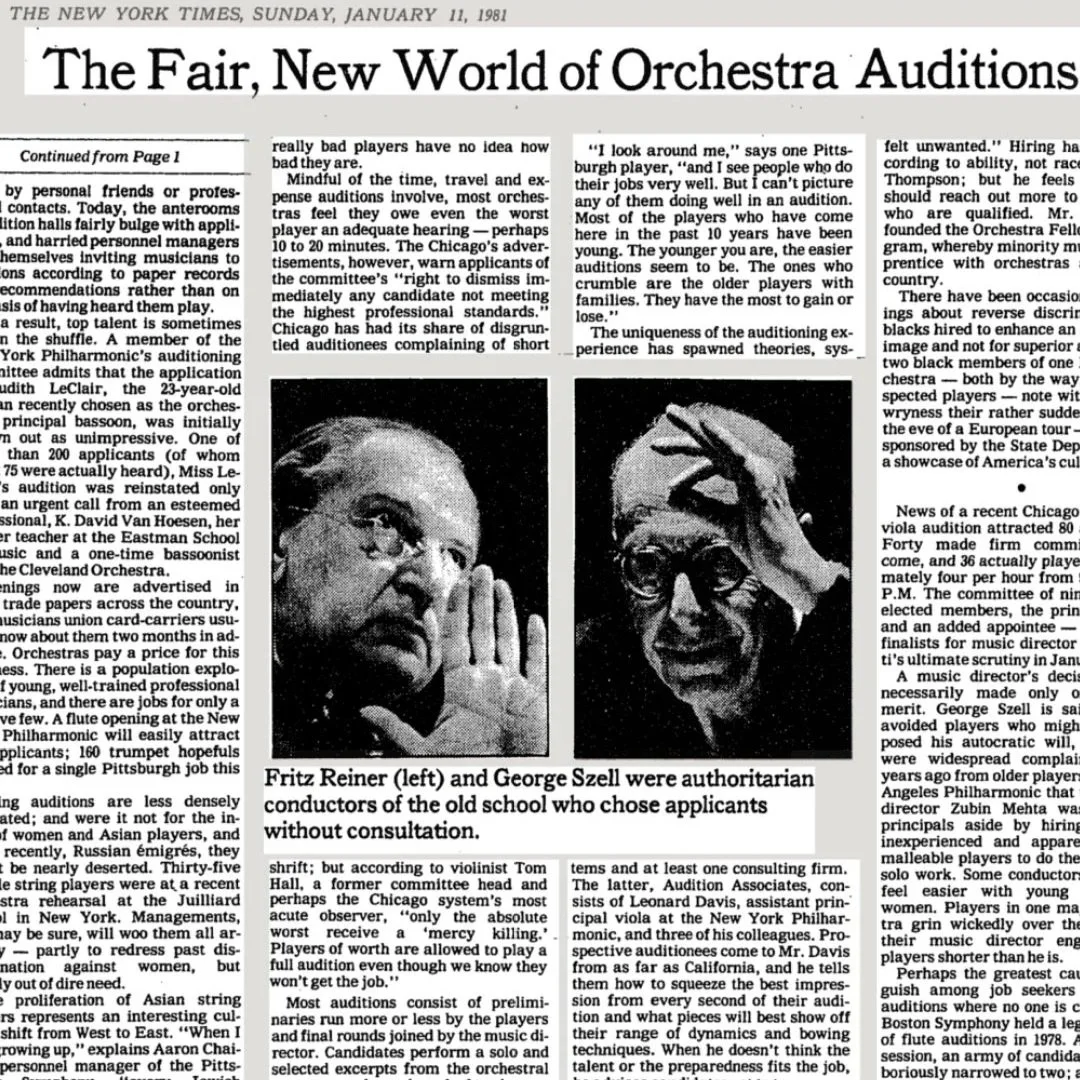
From The New York Times: January 11, 1981: “The Fair, New World of Orchestra Auditions”
Pas de Deux begins with an audition.
My very first orchestra audition - my first real one - was for the Philadelphia Orchestra.
That was a mistake. I knew even walking into the warm-up room that I was way out of my league, but I can't blame my lack of advancing past the prelim on anyone other than myself. I wasn't ready.
I'd be hard-pressed to feel "ready" to audition for Philly now, 19 years later, if that tells you anything.
And to be completely honest, that's what I remember from the audition: it went fine. I do remember my left-hand flying off the fingerboard for seemingly no reason at all, floating through the universe until I slapped it back on in the middle of a scale in Beethoven Seven. Long story short, my not advancing was not a surprise.
Most of my auditions fall into that category: I remember only the vaguest of details, because there were very few disasters.
There was a wonderful (awful) surprise in Minnesota, where I thought I'd be behind a screen and dressed for the weather (hint: polar vortex in Minneapolis). Think thickest jeans possible, a sweater that was peak fuzzy and warm, and a t-shirt layered underneath with a cartoon cat masquerading as a hot-dog.
There was no screen.
Every other candidate was dressed to the nines: concert blacks, shiny shoes, hair done.
I'd come in with a hat and gloves on. My hair was… well, imagine accordingly.
Anyway, I had to keep the sweater on to prevent them from seeing the hot-dog cat, so I played my round running about a thousand degrees, red-faced with heat and my own embarrassment, and it still went… fine.
Even without the anonymity granted by screen, I felt respected. I was given more than enough time to play and prove what I could (and couldn't) do. Across my audition run, I have enjoyed the benefit of carpeted runs on stage to prevent the committee from distinguishing heels versus flats, and screens to keep them from knowing my race, gender, or general appearance. Proctors have spoken for me. Lists have been curated to either be exactly the same from start to finish (assigned Bach?! The horror!). Some orchestras reveal their excerpts one at a time on stage.
Across my time serving on committees, I’ve seen equal time rules: each candidate is able to play for at least five minutes. It seems incredibly short out of context, but what a gift when you've been cut after an agonizing three months of preparation and thirty seconds on stage. We've taken away committee discussions of candidates until after the voting each round, and only allow it if a candidate is within a vote or two of advancing. We keep the screen up through the entire process, including finals and super finals.
In the year of whatever Sweet Baby Deity you believe in 2026, duh.
Pas de Deux, on the other hand, takes place eighty years ago, and the audition it opens with is a horror story I've heard time and time again across the generations of musicians I've worked with. This article from the New York Times in 1981 does a fairly good job at summing up where things were before this herculean attempt at fairness by our Nation's Top Men™: "The Fair, New World of Orchestra Auditions"
You’ll notice that there’s an overall theme to the article, though: what happens if the best talent gets drowned when we open the floodgates to everyone? In 2026, a different question seems more appropriate: what if the best talent can’t get to the audition? What if they can’t afford the gas or the plane ticket to make the trip? What if they can’t take off work long enough to leave town or even get their practicing in?
What if a committee is determined to hire the person they want, and not necessarily the best person at the audition?
"Gone as well is overt sexual and racial discrimination[...]." It’s a nice thought for 1981. Forty-five years later, people are still going to people. When orchestra commit to making auditions as equitable as possible, they chip away at the discrimination that starts well before a candidate even gets close to the door of the concert hall… but it’s a process, not a check-mark on a list.
In Pas de Deux, our fictional heroine, Charlotte "Charlie" Miller, begins the book by walking on stage as herself. It’s July 1946. There is no carpet. There is no screen. There is a committee, run by a tyrant (not even the Music Director!), who is already bored and irritated by the women he has to hear "in fairness" throughout the day. Charlie's preparation has consumed her life, her dream more important than anything else she can conceive of… and she's cut off at the knees before she can even get going. In more ways than one. Is it any wonder she's driven to do something drastic?
From 2009 - 2018, I took… a lot of auditions, and some of them worked out. Not once did I feel cut off at the knees, no matter how the course of the day went. And I still battled the insecurity, depression, and rebuilding that bloomed after each one, like a dark little rose bush. You build a lot of character going through this process, even when it’s fair to you.
The joy of Pas de Deux is that the story only begins with that horrible audition. We get to see Charlie's work toward triumph over the course of the book (spoiler). But… writing that opening scene, I could feel her indignation. I understood her anguish.
And I know, that if I existed in her generation, or the generation of that 1981 article, indignation would be a conflagration. We have come so far, my friends, and we still have such a ways to go.